
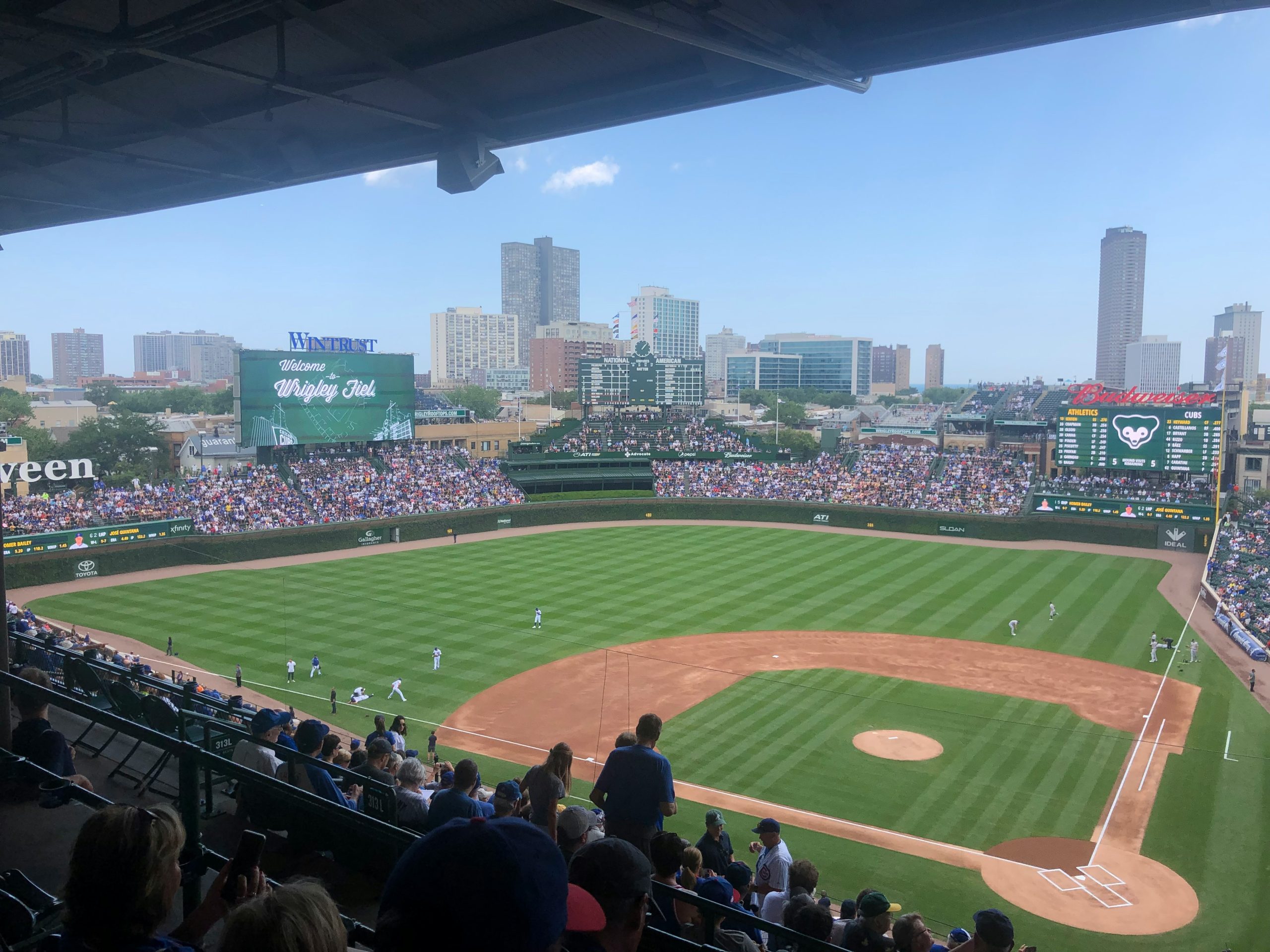
Wrigleyville, Chicago, Illinois
Managed IT Services, Event-Scale Hospitality Technology & PCI DSS Compliance for Wrigleyville’s Venues, Residential Developments & Professional Community
Wrigleyville is one of the most commercially distinctive neighborhoods in American sports geography — a residential and entertainment district whose identity is inseparable from Wrigley Field, the second-oldest active ballpark in Major League Baseball (opened 1914, capacity 41,649), whose ivy-covered brick outfield walls, hand-turned manual scoreboard, and 108 years of championship drought followed by the 2016 World Series title have made it one of the most recognized sports venues on earth. But Wrigleyville in 2026 is not what it was twenty years ago — the accidental sports entertainment district that grew organically around the ballpark has been deliberately and substantially transformed by the Ricketts family’s half-billion-dollar investment in the stadium renovation and surrounding mixed-use redevelopment. The result is a neighborhood that functions as a 365-day destination, not a seasonal venue.
Gallagher Way — the 39,000-square-foot open-air plaza on the stadium’s third-base side, developed by the Ricketts family’s Hickory Street Capital — hosts concerts, film screenings, outdoor markets, a winter ice-skating rink, and the pre-game celebrations that make it the functional town center of Wrigleyville twelve months a year. Hotel Zachary — the 173-room boutique hotel directly across Clark Street from the historic marquee, inspired by Zachary Taylor Davis (the Chicago architect whose 1914 Wrigley Field design made him, in the assessment of those who followed him, the Frank Lloyd Wright of baseball architects) and developed by Hickory Street Capital with architecture by Stantec — anchors the Clark Street corridor with Big Star (Executive Chef Paul Kahan), Smoke Daddy BBQ with live music seven nights a week, and the Budweiser Brickhouse Tavern’s four bars and two outdoor terraces with direct Wrigley Field views. The Residences at Addison & Clark — M&R Development’s 148-unit luxury residential tower directly across from the stadium, designed by Solomon Cordwell Buenz with rooftop access to game-day field views — is the flagship of Wrigleyville’s residential transformation from a game-day corridor into a year-round professional neighborhood.
And the 2026 concert season at Wrigley Field — including RÜFÜS DU SOL (June 12), John Mulaney’s landmark first-ever comedy event at the Friendly Confines (July 11), Tyler Childers with Jon Batiste (July 12), Noah Kahan’s two-night run (July 14-15), and Mumford & Sons — ensures that Wrigleyville’s hospitality corridor will face the kind of 40,000-person demand surges on non-baseball event nights that separate venues and businesses prepared for peak-load technology infrastructure from those discovered not to be.
Lionhive provides Managed IT Services, Event-Scale Hospitality Technology, PCI DSS 4.0 Compliance, Redundant Connectivity Infrastructure, Luxury Residential Property Technology, and vCIO Advisory to Wrigleyville’s bars and restaurants, entertainment venues, boutique hotel operations, luxury residential developments, and the professional services organizations whose boutique offices occupy the lofts above Clark Street’s commercial corridor.
A POS system that processes transactions cleanly during a Tuesday afternoon Cubs game against the Cardinals is not validated until it handles the transaction volume of a sold-out John Mulaney comedy show on a Saturday night in July — when 41,000 people are leaving Wrigley Field simultaneously and every bar, restaurant, and retail operation on Clark Street is processing payment at maximum capacity. The technology infrastructure that works at average load and fails at peak load is not infrastructure. It is a liability. Wrigleyville’s hospitality community needs IT built for the highest-demand moments, not the median ones.
Wrigley Field, Gallagher Way & the Event-Density Challenge
Wrigley Field’s 81-game home schedule creates a concentrated block of high-demand evenings between April and October — but baseball is no longer Wrigleyville’s only driver of peak technology demand. The concert program at Wrigley Field has grown steadily since concerts began in 2005, and the 2026 season’s calendar — John Mulaney’s first-ever comedy show at the Friendly Confines, Tyler Childers, RÜFÜS DU SOL, Noah Kahan’s two-night stand, and Mumford & Sons — brings Wrigley Field’s 41,649-capacity event schedule to a level where concerts contribute event nights that rival and occasionally exceed the commercial intensity of playoff baseball. The Gallagher Way Budweiser Concert Series adds programmed events throughout the season. The winter ice-skating rink draws foot traffic during the months when the Cubs are in Florida. Wrigleyville’s hospitality community no longer has an offseason.
The commercial consequence of this year-round, event-dense calendar for the bars and restaurants on Clark Street, Addison Street, and Sheffield and Waveland Avenues is a technology demand profile unlike any other Chicago neighborhood. On a concert night or a playoff game, the blocks immediately surrounding Wrigley Field sustain transaction volumes per square foot that rival the busiest commercial districts in the city — and the businesses generating those transactions are operating in buildings whose legacy electrical infrastructure and variable connectivity options reflect Wrigleyville’s residential neighborhood character rather than purpose-built commercial infrastructure. The intersection of extremely high peak demand with the infrastructure reality of a residential neighborhood is Wrigleyville’s defining IT challenge.
PCI DSS 4.0 — mandatory since March 2025 — requires every Wrigleyville hospitality operator processing cardholder transactions to maintain quarterly external vulnerability scans by an Approved Scanning Vendor (ASV), quarterly internal authenticated scans, and annual penetration testing of the cardholder data environment under Section 11.4. The network segmentation requirement that isolates POS systems from guest Wi-Fi — ensuring that the free guest wireless network serving a restaurant full of Cubs fans does not share network infrastructure with the credit card processing systems handling their transactions — is the most commonly misconfigured control in high-volume hospitality environments. Lionhive implements PCI DSS 4.0-compliant network architecture for Wrigleyville’s hospitality operators, building the cardholder data environment segmentation, quarterly scanning program, and annual penetration testing cadence that PCI compliance requires — before a QSA assessment or a cardholder data breach makes compliance urgent.
The Illinois Biometric Information Privacy Act (BIPA) — with $1,000 to $5,000 per-violation statutory damages and a private right of action that has produced class action litigation specifically targeting Illinois restaurant and hospitality employers — creates active compliance obligations for every Wrigleyville bar, restaurant, and entertainment venue using fingerprint time-and-attendance systems, biometric employee POS authentication, or facial recognition access control. Lionhive builds BIPA-compliant biometric governance programs — written consent and disclosure procedures, retention and destruction schedules, vendor management documentation — for Wrigleyville’s hospitality operators before the class action exposure that biometric systems without proper compliance governance create materializes.
Redundant Connectivity — The Non-Negotiable Foundation
For Wrigleyville’s hospitality community, internet connectivity is not a utility — it is the operational infrastructure that payment processing, kitchen display systems, mobile ordering, and real-time inventory depend on. A single-provider internet connection that goes down during the seventh inning of a playoff game, or during the post-show rush following a 41,000-person concert, is not a service interruption. It is a revenue catastrophe whose duration is measured in the hours it takes a cable technician to arrive, by which time the evening’s peak revenue window has closed.
Lionhive deploys redundant connectivity architecture for Wrigleyville’s hospitality operators — primary fiber through business-grade ISPs including Comcast Business or RCN Business, with automatic 5G failover through T-Mobile Business or Verizon Business that activates within seconds of primary connection failure. The failover architecture is transparent to POS systems and payment processors — a connectivity failure does not create a POS offline state or trigger payment processing errors. It is invisible to staff and guests. Proactive monitoring through Lionhive’s Managed SOC identifies network performance degradation before it becomes a service failure — the “Opening Day Audit” mentality that ensures every critical system is validated before the first pitch and the first chord of the first concert of the season.
Enterprise wireless architecture designed for high-density occupancy — deploying Cisco or Ubiquiti UniFi access points with capacity management that prioritizes POS and operational traffic over guest Wi-Fi during peak service — ensures that a restaurant serving 300 guests simultaneously during a concert night maintains operational connectivity even when every guest device is actively connected to the guest network.
Hotel Zachary, Gallagher Way & the Boutique Hospitality Technology Standard
Hotel Zachary‘s position as Wrigleyville’s luxury hospitality anchor — a 173-room boutique hotel whose culinary program includes Big Star, Smoke Daddy, and the Budweiser Brickhouse Tavern, and whose guest experience is calibrated to the expectations of travelers specifically choosing Wrigleyville for its proximity to the Friendly Confines — establishes the technology standard that the neighborhood’s hospitality operators are implicitly measured against. Property management system integration with guest-facing services, high-availability guest Wi-Fi across a boutique hotel’s variable occupancy patterns, the AV and event management technology supporting the American Airlines Conference Center’s 5,000 square feet of meeting space, and the PCI DSS compliance requirements of a hotel processing cardholder transactions across room charges, food and beverage, and event bookings constitute a hospitality technology environment whose complexity mirrors the quality of the guest experience it supports.
For the broader hospitality community operating in Hotel Zachary’s commercial shadow — the bars and restaurants along Clark Street whose business performance on game and concert nights is directly correlated with the visitor traffic that the Gallagher Way complex generates — the technology standard set by the anchor development creates both an expectation and a competitive requirement. Guests arriving for a Wrigley Field concert and encountering a POS system that freezes during checkout, or a restaurant whose guest Wi-Fi is overloaded, or a bar whose contactless payment reader goes offline during peak service, form impressions that extend beyond the individual establishment to the neighborhood. Lionhive’s hospitality IT programs for Wrigleyville are built to the standard the neighborhood’s anchor development sets.
Addison & Clark and Wrigleyville’s Luxury Residential Transformation
The Residences at Addison & Clark — M&R Development’s 148-unit transit-oriented luxury residential tower directly across from Wrigley Field at the Clark and Addison intersection, designed by Solomon Cordwell Buenz with Lucky Strike bowling, a movie theater, and 155,000 square feet of retail anchoring the ground floor — represents the residential half of Wrigleyville’s transformation from game-day destination to year-round urban neighborhood. The building’s rooftop access to game-day Wrigley Field views is the ultimate neighborhood-specific amenity — the kind of place-specific residential offering that no amount of building finishes or fitness center equipment can replicate in any other location in Chicago.
For property managers at Addison & Clark and the broader luxury residential inventory that has followed Wrigleyville’s redevelopment — the young professionals and executives who choose Wrigleyville specifically because they want to live inside the entertainment district rather than commute to it — the technology requirements span building access control, tenant communication platforms, and the leasing CRM infrastructure that manages the competitive high-value rental market that proximity to Wrigley Field creates.
Cloud-based access control systems — providing smartphone-credential building entry, package locker management, and visitor management platforms — are the expected standard for Wrigleyville luxury residential. Lionhive integrates building access control, video surveillance, and property management systems through the operational infrastructure that competitive luxury residential management requires. For leasing operations managing high-value units in a neighborhood whose proximity to Wrigley Field is a genuine competitive differentiator, CRM platforms through Salesforce or HubSpot integrated with leasing management software optimize the inquiry-to-lease pipeline for the tenant profile that Wrigleyville’s residential development attracts.
The Professional Community Above the Rooftops
Tucked above Clark Street’s ground-floor hospitality corridor — in the boutique office spaces, converted apartments, and loft offices above the retail level — is a professional community of wealth managers, sports and talent agents, creative consultants, media professionals, and specialized professional services providers whose proximity to Wrigleyville’s concentration of athletes, entertainers, media, and high-income residential population is a commercial advantage rather than an incidental consequence of where they work. Sports agents, athlete management firms, and the financial advisory practices serving professional athletes and entertainers who choose to live in Chicago’s most recognizable neighborhood face a data privacy and security environment whose sensitivity reflects the commercial value of what they protect.
Wealth management and financial advisory practices handling client investment portfolios and personal financial data face FINRA cybersecurity examination requirements, FTC Safeguards Rule obligations for non-bank financial institutions, and the data governance requirements that the professional ethics of financial advisory impose. For these organizations, the vCIO advisory and strategic technology leadership that Lionhive provides — building the security program, cloud governance infrastructure, and compliance documentation that their regulatory environment and institutional client relationships require — is as commercially relevant as the POS reliability that defines Wrigleyville’s hospitality technology requirements.
Private schools, tutoring academies, and the specialized educational organizations serving Wrigleyville and the broader Lakeview community face FERPA student data governance obligations and the specific SIS platform requirements — PowerSchool, Skyward, Infinite Campus — whose optimization is Lionhive’s specialized educational technology capability. For the school administrator whose student information system integration is generating reporting errors three days before a board presentation, or whose FERPA data governance documentation has never been formally implemented, Lionhive’s educational technology practice provides both the technical implementation and the compliance governance that their institutions require.
Seasonal Readiness — Opening Day, Concert Season & the High-Season Tech Audit
Wrigleyville’s hospitality and commercial community faces a seasonality pattern that compresses the preparation requirement into a narrow window. The Cubs’ Home Opener — typically in early April — is the first major test of every POS system, connectivity stack, and payment processing infrastructure in the neighborhood after the winter. A network bottleneck discovered at 2pm on Opening Day is not discovered at a convenient time. Neither is a POS authentication failure discovered during the pre-show rush for a July concert that has sold out Wrigley Field’s 41,649 seats.
Lionhive conducts pre-season technology audits for Wrigleyville’s hospitality community — the Opening Day check and High-Season Tech Audit that validate POS system performance, connectivity failover function, network segmentation integrity, and payment processing throughput before the season’s first major demand event. Every hardware component is tested, every failover mechanism is verified, and every PCI DSS control is confirmed operational before the neighborhood’s peak revenue period begins. The preparation that separates the venues whose technology is invisible to guests from those whose technology becomes the story on the neighborhood’s highest-demand nights is a deliberate practice, not a function of luck.
Core Services for Wrigleyville Organizations
Event-Scale Hospitality IT & Connectivity — Redundant fiber/5G connectivity with automatic failover, PCI DSS 4.0-compliant network architecture with cardholder data environment segmentation, enterprise wireless designed for high-density occupancy, POS system integration and monitoring, and the proactive technology audit program that ensures systems are validated before Opening Day and every major event night.
PCI DSS 4.0 Compliance — Quarterly ASV external scanning, quarterly authenticated internal scanning, annual penetration testing under Section 11.4, and the network architecture that maintains CDE segmentation through Wrigleyville’s complex multi-use environments where guest Wi-Fi, POS systems, and back-office networks share physical space but must be logically isolated. Built for the actual PCI DSS 4.0 standard, not the previous version’s flexibility.
Illinois BIPA Compliance — Written consent programs, biometric data retention and destruction schedules, and vendor management documentation for Wrigleyville’s hospitality and retail employers using biometric time-tracking, employee POS authentication, or access control systems.
Luxury Residential Property Technology — Cloud-based access control, video surveillance integration, tenant communication platforms, and leasing CRM through Salesforce and HubSpot for Wrigleyville’s luxury residential developments.
Managed IT Services — 24/7 monitoring, patch management, backup validation, and helpdesk support calibrated to Wrigleyville’s operational schedule — response capability available during evening and weekend peak service hours, not exclusively during business hours for a neighborhood whose critical operational periods are Friday evenings, weekend afternoons, and every concert night from May through September.
Cybersecurity & Compliance — NIST CSF 2.0-aligned security programs, endpoint detection and response via CrowdStrike, identity management through Microsoft Entra ID, FINRA Safeguards Rule and FERPA compliance programs for Wrigleyville’s financial advisory and educational organizations, and Dark Web Monitoring for credential exposure alerting across the neighborhood’s professional services community.
vCIO Advisory — Strategic technology leadership for Wrigleyville’s professional services firms, boutique agencies, and sports and entertainment management organizations whose operations require C-suite technology guidance calibrated to their specific client base and regulatory environment.
Educational Technology & SIS Consulting — PowerSchool, Skyward, and Infinite Campus student information system optimization, FERPA compliance governance, and managed IT for the private schools and educational organizations serving Wrigleyville and the broader Lakeview community.
📞 Partner with Lionhive in Wrigleyville
In a neighborhood that never stops — 81 Cubs home games, a summer concert season whose 2026 calendar includes John Mulaney’s first-ever comedy show at the Friendly Confines, a year-round Gallagher Way event program, and the luxury residential and professional community that has grown up inside one of Chicago’s most recognizable destinations — your technology cannot afford to stop either. Lionhive provides Wrigleyville’s bars, restaurants, entertainment venues, residential developments, and professional services organizations with the event-grade IT infrastructure, PCI DSS compliance depth, and always-on support that this neighborhood’s operational demands require. To discuss your IT, cybersecurity, or hospitality technology requirements, contact us directly or book a strategy session.
👉 Book a Wrigleyville Strategy Session
📞 +1 469 364 9010
Part of Lionhive’s Chicago, Illinois coverage — serving organizations across Wrigleyville, Lakeview, River North, and throughout Chicago.