
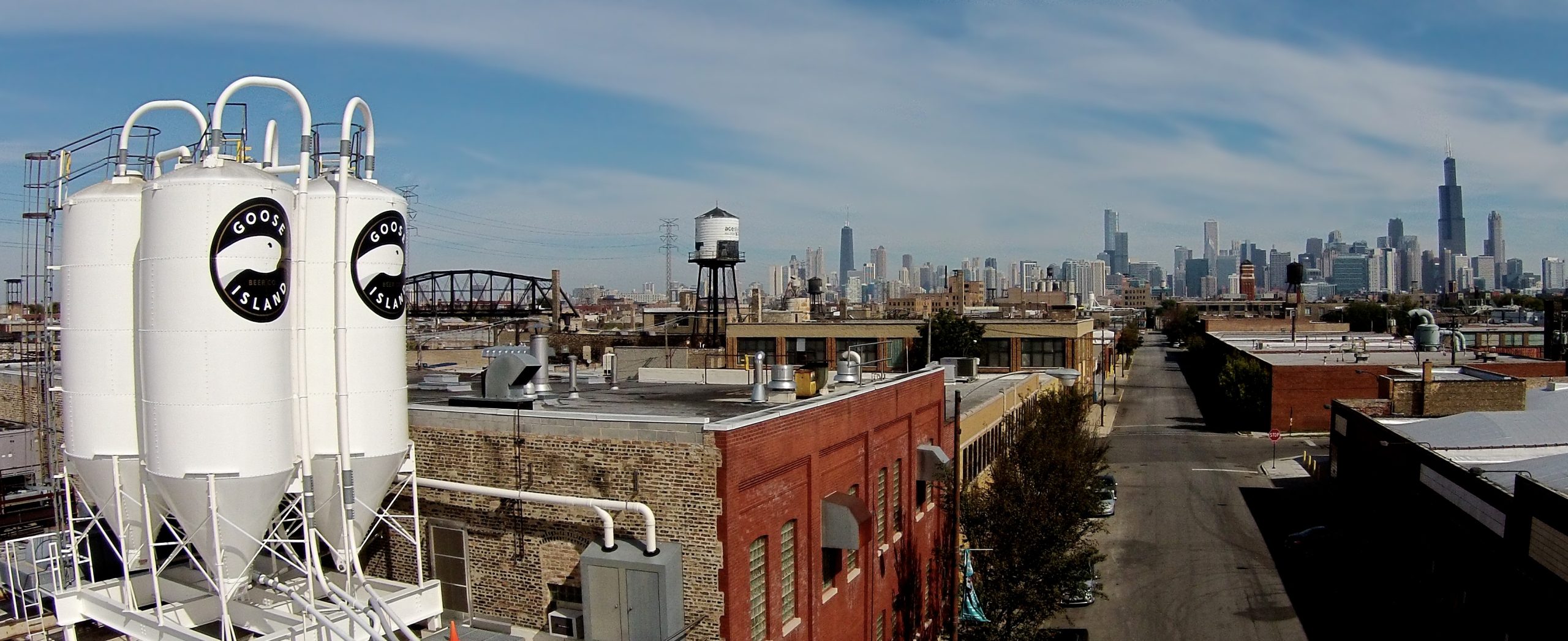
Goose Island, Chicago, Illinois
Managed IT Services, OT/IT Integration & Advanced Manufacturing Technology for Goose Island’s Innovation & Industrial Community
Goose Island is Chicago’s only island — a 160-acre strip of land formed in 1853 when the North Branch Canal was dredged through what had been a bend in the North Branch of the Chicago River, creating a unique geographic enclave surrounded by the river on both sides, bounded by Division Street to the south and extending north toward Cortland Street, accessible via bridges at Halsted Street, Division Street, and Clybourn Avenue. The island’s industrial heritage — tanneries, breweries, soap factories, grain elevators, and coal yards that made it a 19th-century manufacturing hub — is being superseded by a 21st-century identity as one of Chicago’s most concentrated advanced manufacturing, food technology R&D, and digital manufacturing innovation environments. Developers and city planners have used terms including Silicon Island and Innovation Island to describe the trajectory. What is actually happening on Goose Island in 2026 validates those descriptions with specific anchors whose technology and compliance requirements define the neighborhood’s commercial character.
Mars Wrigley — the global confectionary company whose brands include Snickers, M&Ms, Twix, Milky Way, Skittles, Starburst, and the Wrigley gum portfolio — employs approximately 950 people at Goose Island across Mars Wrigley, Mars Food, and Mars Global Services. The company’s Global Innovation Center at the northern terminus of the island has served as Mars Wrigley’s global confectionary headquarters since 2016 — the largest innovation hub in the Mars Wrigley global network — where the company’s R&D program has generated six patents in a single year from Goose Island alone, covering everything from new product formulations to packaging innovation. In 2022 Mars Wrigley broke ground on a $40 million R&D expansion hub adjacent to the existing Global Innovation Center, adding test kitchen facilities, state-of-the-art pilot production lines, and breakthrough technology development capabilities that make Chicago home to the largest Mars Wrigley innovation operation in the world.
DMG MORI — one of the world’s leading manufacturers of high-precision CNC machine tools used in automotive, aerospace, medical device, and advanced manufacturing applications — is investing $40.5 million in a new advanced manufacturing facility on Goose Island, opening in 2026 and creating 74 full-time positions across machine operation, engineering, maintenance, research, and office roles, supported by a workforce training program through City Colleges of Chicago. MxD (Manufacturing x Digital) — formerly the Digital Manufacturing and Design Innovation Institute (DMDII), the federally funded advanced manufacturing research consortium backed by a $70 million federal commitment and operating from a 94,000-square-foot facility in the former Republic Windows & Doors building at 930 West Evergreen Avenue — brings together academia, industry, and government in pursuit of digital manufacturing innovation whose cybersecurity implications for industrial operations are central to its research mission. And Kendall College — the Chicago culinary arts and hospitality management institution whose campus occupies the former Sara Lee Corporation R&D and headquarters building at the southern end of the island — anchors Goose Island’s educational and hospitality technology dimension.
Lionhive provides Managed IT Services, OT/IT Integration, Industrial Cybersecurity, FDA 21 CFR compliance for food R&D environments, CMMC 2.0 advisory for federal manufacturing research, and Co-Managed IT to the advanced manufacturing facilities, food technology R&D organizations, digital manufacturing research institutions, logistics operators, and adaptive-reuse creative office tenants operating across Goose Island’s industrial and innovation landscape.
Goose Island is not a neighborhood where IT infrastructure is a back-office consideration. When your operational technology controls a $40 million precision CNC manufacturing facility, or your R&D systems are generating patents for one of the world’s most recognized food brands, or your research data constitutes the federally funded output of a national digital manufacturing program — the security and reliability of the technology environment is as operationally consequential as the machines and laboratories it connects. Goose Island requires IT partners who understand both environments.
Mars Wrigley Global Innovation Center — Food Technology R&D & Supply Chain Compliance
Mars Wrigley’s Goose Island campus represents one of the most significant corporate R&D concentrations in Chicago — a 950-person innovation ecosystem whose work spans product development, food science research, packaging innovation, pilot manufacturing, and the global supply chain management that connects the Goose Island campus to Mars Wrigley’s manufacturing operations around the world. The Global Innovation Center’s state-of-the-art laboratory facilities, pilot production lines, test kitchens, and consumer research capabilities constitute a technology environment whose complexity is proportionate to the scale of what it produces: globally distributed confectionary products manufactured at volumes that make food safety, quality control data integrity, and supply chain security foundational operational requirements.
Food manufacturing and R&D organizations whose processes are subject to FDA oversight operate under specific regulatory frameworks that create IT governance obligations. FDA’s Food Safety Modernization Act (FSMA) requires documented food safety plans, preventive controls for hazards, supply chain program documentation, and recall procedures — each of which has a data governance dimension that defines how production data is created, maintained, and accessible for regulatory review. For food technology R&D producing patent applications, the intellectual property protection obligations are significant — proprietary formulations, process parameters, and research data represent years of R&D investment whose unauthorized disclosure would constitute both a competitive catastrophe and, where trade secrets are involved, a federal legal matter. The FBI’s economic espionage guidance specifically identifies food technology and consumer products R&D as targeted categories for nation-state and corporate espionage.
The professional services vendors, technology suppliers, and consulting organizations whose engagements include Mars Wrigley’s Goose Island campus encounter procurement security questionnaire requirements calibrated to the standards of a global company whose brands serve hundreds of millions of consumers. Passing Mars Wrigley’s vendor security assessment — or the equivalent from any large consumer goods manufacturer — requires documented information security programs, MFA deployment, endpoint protection, incident response procedures, and often SOC 2 Type II certification. Lionhive builds the security programs that allow Goose Island professional services and technology organizations to satisfy these requirements and maintain relationships with the island’s dominant anchor employer.
Supply chain cybersecurity is a specific and growing obligation for consumer goods manufacturers operating at Mars Wrigley’s scale. Ingredient suppliers, co-manufacturers, logistics providers, and quality testing laboratories whose systems connect — directly or indirectly — to Mars Wrigley’s production data environments create attack surface across an extended supply chain that the company’s security program actively manages. The technology vendors serving those supply chain participants face the downstream security requirements of those supply chain relationships. Lionhive addresses supply chain cybersecurity for Goose Island’s manufacturing ecosystem — vendor risk management documentation, security control assessment and remediation, and the access governance that controls what external parties can reach within a manufacturer’s operational technology environment.
DMG MORI Advanced Manufacturing — OT/IT Integration & Industrial Cybersecurity
DMG MORI‘s new $40.5 million Goose Island facility — opening in 2026, manufacturing and servicing high-precision CNC machine tools used in automotive, aerospace, medical device, and semiconductor manufacturing — is among the most technologically sophisticated new industrial facilities in Chicago. CNC machine tools are the production equipment that creates the precision components in automobiles, aircraft, and medical implants — whose manufacturing tolerances are measured in microns and whose production data systems track every cut, every tool change, and every quality measurement in real time. The operational technology environment of a precision CNC manufacturing facility — PLCs controlling machine motion, SCADA systems monitoring production parameters, quality control data collection systems, and the industrial IoT sensors that enable predictive maintenance and production analytics — creates the OT/IT convergence challenge in its most technologically intensive form.
CNC machine tools are export-controlled items under the Bureau of Industry and Security (BIS) Export Administration Regulations — precision machine tools above specific capability thresholds are subject to export licensing requirements, and the technology data associated with controlled CNC machines — specifications, programming, capability data, and the technical parameters that define machine performance — may constitute controlled technology requiring technology control plan governance for access by foreign nationals. DMG MORI’s Goose Island operation, serving customers across aerospace, defense-adjacent medical devices, and other regulated manufacturing sectors, faces vendor and customer security requirements whose specificity reflects the sensitivity of what the machines produce.
Lionhive designs and implements OT/IT integration and industrial cybersecurity for Goose Island’s precision manufacturing environment — industrial DMZ network architecture isolating production control systems from corporate IT while enabling the data flows that analytics and remote diagnostics require, ISA/IEC 62443-aligned security design for industrial control system environments, Zero Trust Network Access replacing legacy VPN for secure remote access to operational technology, and export control technology control plan governance through Microsoft Entra ID identity and access management that governs who accesses controlled technical data and creates the audit records that BIS compliance requires.
MxD — Digital Manufacturing Research, Federal Compliance & CMMC
MxD (Manufacturing x Digital) — operating from the 94,000-square-foot former Republic Windows & Doors facility at 930 West Evergreen Avenue on Goose Island — is a federally designated Manufacturing USA institute whose mission is accelerating US digital manufacturing capability through research, workforce development, and technology deployment. Backed by the Department of Defense and a consortium of over 300 industrial, academic, and government members, MxD operates applied research programs in cybersecurity for manufacturing, digital thread implementation, and advanced manufacturing process innovation whose federal program context creates specific compliance obligations.
Federal manufacturing research programs handling Department of Defense-related data face CMMC 2.0 (Cybersecurity Maturity Model Certification) requirements for Controlled Unclassified Information — the federal cybersecurity compliance standard that defense industrial base organizations and their contractors must meet as a condition of DoD contract participation. For MxD’s member organizations whose engagement with the institute’s research programs involves DoD-funded research data, CMMC Level 2 compliance — requiring 110 security controls aligned with NIST SP 800-171 — is an active compliance requirement. The manufacturing companies, technology vendors, and research organizations participating in MxD’s programs who handle CUI in connection with their MxD engagement need CMMC-aligned security programs and the documentation that DoD contracting officers require.
MxD’s cybersecurity for manufacturing research program — which examines how industrial control systems, factory floor networks, and digital manufacturing data environments can be protected against the sophisticated threat actors who target US manufacturing capability — creates a specific irony: the institute whose mission includes securing manufacturing systems operates in an environment where its own systems must meet the security standards it researches and promotes. Lionhive provides CMMC 2.0 advisory and NIST CSF 2.0-aligned security programs for the Goose Island innovation ecosystem organizations whose federal research relationships and manufacturing sector client engagements require demonstrated compliance maturity.
Goose Island Beer Company & Industrial Adaptive Reuse Tenants
Goose Island Beer Company — whose name comes directly from this neighborhood and whose original brewery on Clybourn Avenue launched the craft beer movement that would eventually make Chicago a nationally recognized brewing city — maintains taproom operations and production facilities whose PCI-compliant payment infrastructure, inventory management systems, and visitor management technology create the standard managed IT requirements of a hospitality and food production operation. Now part of Anheuser-Busch InBev’s craft portfolio, Goose Island’s Goose Island operations face the vendor security and compliance requirements that flow from their parent company’s enterprise procurement standards.
The adaptive reuse developments reshaping Goose Island’s commercial inventory — including R2 Companies’ conversions of former industrial buildings at 909 West Bliss Street and 934 North Branch Street into creative loft office space — attract the technology companies, design studios, creative agencies, and innovation-oriented professional services organizations that prefer Goose Island’s industrial character and riverfront access over the more established (and more expensive) River North and West Loop alternatives. These tenants face the same legacy building connectivity challenge as Printers Row — historic industrial masonry and steel construction that wasn’t designed for modern data cabling — alongside the same cloud governance, cybersecurity, and compliance requirements as their counterparts in more established Chicago commercial districts.
For creative and technology tenants in Goose Island’s adaptive reuse buildings, Lionhive provides enterprise wireless infrastructure appropriate for open-plan industrial loft environments, fiber and 5G connectivity solutions that address historic building constraints, and the cloud and cybersecurity infrastructure that technology companies and professional services firms operating from Goose Island’s converted warehouse spaces require to serve enterprise and institutional clients whose vendor security requirements reflect the sophistication of their own operations.
Kendall College — Culinary Education & Hospitality Technology
Kendall College — occupying the former Sara Lee Corporation R&D and headquarters building at the southern end of Goose Island, now part of Saint Xavier University — provides culinary arts and hospitality management education in one of Chicago’s most distinctively industrial campus settings. Culinary education institutions manage student educational records under FERPA, operate commercial-scale teaching kitchen environments with food safety documentation requirements, and provide the hospitality management education whose technology dimension — restaurant management systems, point-of-sale training platforms, and hospitality operations software — creates specific educational technology requirements that general campus IT approaches don’t fully address. Lionhive provides FERPA-aligned managed IT and educational technology support for Kendall College’s Goose Island operations, alongside the broader managed IT services that support the campus’s administrative and student-facing technology environment.
Illinois BIPA & Manufacturing Employers
Goose Island’s manufacturing and industrial facilities — Mars Wrigley’s production operations, DMG MORI’s precision manufacturing facility, and the industrial organizations operating across the island’s maintained industrial zoning — make heavy use of biometric access control systems, fingerprint time and attendance tracking, and facility security technology for workforce management across 24/7 production environments. The Illinois Biometric Information Privacy Act (BIPA) — with $1,000 per negligent violation and $5,000 per intentional violation statutory damages and a private right of action that has specifically targeted manufacturing and industrial employers — creates active compliance obligations for every Goose Island employer using biometric systems for any purpose involving employees or facility visitors. Lionhive builds BIPA compliance infrastructure for Goose Island’s manufacturing community — written consent and disclosure procedures, biometric data retention and destruction schedules, vendor management for biometric system providers, and the documented compliance program that reduces the class action exposure that Illinois manufacturing employers face.
Core Services for Goose Island Organizations
OT/IT Integration & Industrial Cybersecurity — The defining service for Goose Island’s manufacturing community. Industrial DMZ network architecture, ISA/IEC 62443-aligned security design, ZTNA for secure remote access to production systems, and operational technology monitoring that detects threats to industrial control environments before they reach production equipment. The technical foundation that manufacturing organizations on Goose Island need as their operational systems connect to corporate networks and cloud platforms.
Managed IT & Co-Managed IT — 24/7 proactive monitoring, patch management, backup validation, and helpdesk support for Goose Island organizations across food technology R&D, precision manufacturing, digital manufacturing research, culinary education, and creative/technology office tenants. Co-managed IT for organizations like DMG MORI and Mars Wrigley’s vendor ecosystem with existing internal IT teams — extending specialist OT/IT security and compliance capability without replacing internal staff.
CMMC 2.0 Advisory & Federal Research Compliance — NIST SP 800-171 gap assessment, control implementation, and CMMC Level 2 compliance documentation for Goose Island organizations participating in MxD programs, DoD-funded manufacturing research, or defense industrial base supply chains. The federal cybersecurity compliance expertise that Goose Island’s federal research community requires.
FDA Food Safety & R&D Data Governance — FSMA-aligned food safety data management, production records governance, and the intellectual property protection infrastructure for food technology R&D organizations on Goose Island. Protecting the patent-generating research output of the island’s most significant employer is an active security program requirement, not an aspirational goal.
Export Control Technology Control Plans — Identity and access management governance for organizations handling BIS export-controlled technical data — CNC machine technology, advanced manufacturing process data, and the controlled technology that flows through Goose Island’s precision manufacturing operations. Access control, audit trails, and the documentation that BIS compliance requires.
Cybersecurity & Compliance — ISA/IEC 62443, CMMC 2.0, NIST SP 800-171, FDA FSMA, BIPA, Illinois PIPA, FERPA, SOC 2, and NIST CSF 2.0 — integrated compliance programs for Goose Island’s uniquely demanding regulatory environment. Endpoint detection and response via CrowdStrike and SentinelOne, identity management through Microsoft Entra ID and Okta, 24/7 monitoring through Lionhive’s Managed SOC.
Historic Building Connectivity — Enterprise wireless and fiber/5G hybrid connectivity for Goose Island’s adaptive reuse office tenants operating in former industrial buildings whose physical infrastructure predates modern data cabling requirements.
BIPA Compliance — Written consent programs, retention and destruction schedules, vendor management for biometric systems, and the compliance documentation that protects Goose Island’s manufacturing employers from the class action litigation that has specifically targeted Illinois industrial employers.
📞 Partner with Lionhive on Goose Island
Goose Island is Chicago’s most distinctively industrial innovation environment — a 160-acre island where Mars Wrigley’s 950-person global R&D operation, DMG MORI’s new $40.5 million precision manufacturing facility, MxD’s federally funded digital manufacturing research program, and the growing community of technology and creative organizations in adaptive reuse loft offices constitute a commercial community whose technology requirements are among the most technically specific in Chicago. Lionhive serves Goose Island’s manufacturers, R&D organizations, federal research programs, educational institutions, and creative office tenants with the OT/IT integration expertise, industrial cybersecurity depth, federal compliance capability, and managed IT reliability that this island’s ambitions demand. To discuss your IT, cybersecurity, or industrial technology requirements, contact us directly or book a strategy session.
👉 Book a Goose Island Strategy Session
📞 +1 469 364 9010
Part of Lionhive’s Chicago, Illinois coverage — serving organizations across Goose Island, River North, West Loop, The Loop, and throughout Chicago.