
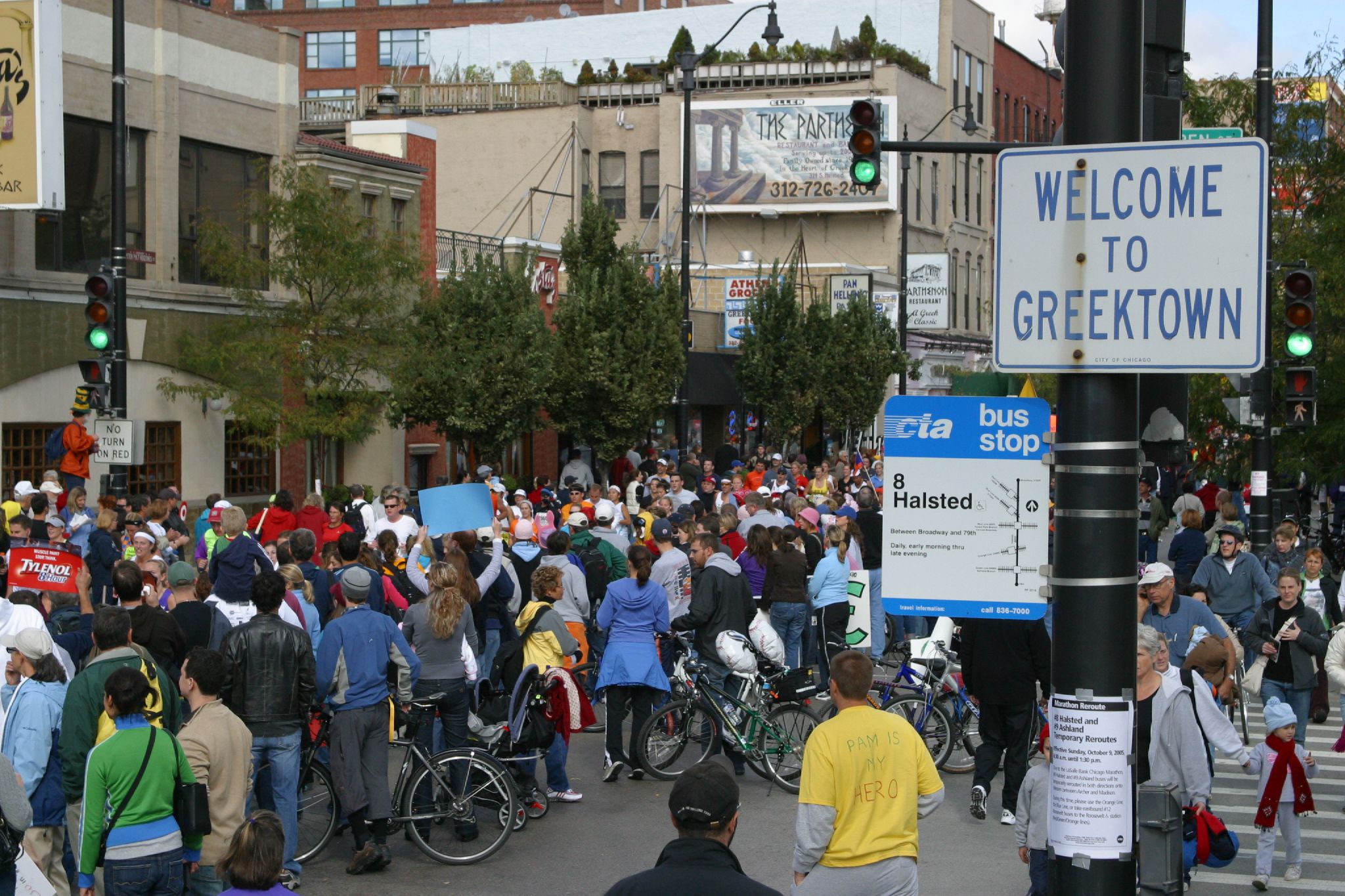
Greektown, Chicago, Illinois
Managed IT Services, Hospitality Technology & Professional Services IT for Greektown’s Restaurant, Cultural & Commercial Community
Greektown occupies a culturally distinct and commercially specific position along South Halsted Street on Chicago’s Near West Side — running between Van Buren and Madison Streets, marked at its major intersections by the Greek temple pavilions the City of Chicago erected in 1996, and anchored by the National Hellenic Museum at 333 South Halsted Street, the only national institution dedicated to preserving the Greek immigrant experience and Greek-American contributions to the United States. The 40,000-square-foot museum, opened in its current Halsted Street building in December 2011 and maintaining a collection of more than 20,000 resources including texts, artifacts, photographs, and oral histories, has served as Greektown’s cultural anchor since its 1983 founding and receives more than 10,000 Chicago public school students annually. The neighborhood’s commercial identity was shaped by Greek immigrant entrepreneurs — gyros and saganaki (flaming cheese) were introduced to the United States by Chicago’s Greektown restaurants in 1968 — and its hospitality community has defined the Halsted Street corridor for more than five decades.
Greektown in 2026 is simultaneously one of Chicago’s most culturally rooted neighborhoods and one of its most commercially dynamic, driven by the extraordinary growth pressure of the adjacent West Loop — where condominium values increased 89.7% from 2015 to 2025, with approximately 39 residential development projects completed between Halsted and Ashland Streets over the same period. The neighborhood’s Walk Score of 97 reflects a commercial density that includes major transit access through the CTA Blue Line UIC-Halsted station at 430 South Halsted and the Green and Pink Line Morgan Station, proximity to the Jane Byrne Interchange handling over 400,000 vehicles daily on I-94 and the Eisenhower Expressway, and six of Chicago’s eleven Metra commuter rail lines converging at Union Station within the broader neighborhood. To the southwest sits the University of Illinois Chicago (UIC) — the largest university in the city, a major research institution, and the institutional neighbor that has defined Greektown’s western boundary since the Eisenhower Expressway and UIC construction in the 1960s displaced the original Greektown community northward to its current location. Immediately west, the United Center at 1901 West Madison Street — home of the Chicago Bulls and Chicago Blackhawks and one of the city’s premier concert venues — drives regular high-density event traffic through the Halsted Street corridor.
Lionhive provides Managed IT Services, Hospitality Technology Infrastructure, PCI DSS Compliance, Co-Managed IT, and vCIO Advisory to Greektown’s restaurant and hospitality operators, retail businesses, professional services organizations, cultural institutions, and the residential property managers whose developments have transformed the neighborhood’s commercial profile over the past decade.
A network outage at 7:30pm on a Friday night in Greektown during dinner service — when every table is full, the POS system is processing continuous cardholder transactions, and the kitchen display systems connecting front-of-house to back-of-house are running at full capacity — is not a Medium priority IT ticket. It is a revenue-critical emergency whose resolution window is measured in minutes, not hours. Greektown’s hospitality community needs IT partners who understand that distinction and have built their response capability around it.
Greektown’s Hospitality Corridor — POS Infrastructure, PCI DSS & Connectivity Resilience
Greektown’s restaurant community — anchored by Greek Islands (established 1971 and expanding from modest beginnings into a Halsted Street institution), Athenian Candle (in operation for over a century), and the approximately nine dedicated Greek restaurants operating along the Halsted Street corridor as of 2025, alongside the broader hospitality and food and beverage operations that have followed the West Loop’s expansion into the neighborhood — constitutes one of Chicago’s densest concentrations of restaurant technology requirements within a compact geographic area. The annual Taste of Greektown festival — in its 35th edition in August 2025, running August 22-24 — brings event-scale technology demands to a neighborhood whose permanent hospitality infrastructure already operates at high intensity on ordinary weekends.
PCI DSS 4.0 — the Payment Card Industry Data Security Standard whose requirements became mandatory in March 2025, replacing version 3.2.1 — governs payment card data security for every Greektown restaurant, bar, and retail operation processing cardholder transactions. The specific requirements most relevant to Greektown’s hospitality operators include: network segmentation isolating the cardholder data environment from guest Wi-Fi and administrative networks (a critical control for restaurants whose POS systems sit on the same network as customer-facing wireless); quarterly external vulnerability scans by an Approved Scanning Vendor (ASV) and quarterly internal vulnerability scans under Requirement 11.3; and annual penetration testing under Requirement 11.4. For Greektown restaurant operators who have historically treated PCI compliance as a checkbox satisfied by their payment processor’s attestation, PCI DSS 4.0’s expanded technical requirements and March 2025 mandatory effective date represent a material change in what compliance actually requires.
Connectivity resilience is the single most operationally consequential technology requirement for Greektown’s hospitality community. A restaurant whose POS system goes offline during dinner service loses revenue, loses tables, and creates the kind of operational disruption that its weekend regulars remember. Lionhive deploys redundant connectivity architecture for Greektown’s hospitality operators — primary fiber from a Tier 1 ISP with 5G failover that activates automatically when the primary connection fails, ensuring that POS systems, kitchen display systems, and table management platforms remain operational through the ISP outages and neighborhood infrastructure events that occasionally affect the Halsted Street corridor’s legacy building stock. Business-grade fiber through carriers including AT&T, Comcast Business, and RCN Business, combined with 5G failover through T-Mobile Business or Verizon Business, provides the connectivity redundancy that Greektown’s dinner-service technology environment requires.
The Illinois Biometric Information Privacy Act (BIPA) creates specific and actively enforced compliance obligations for Greektown’s hospitality employers whose fingerprint time-and-attendance systems, biometric point-of-sale employee authentication, and access control systems collect biometric identifiers from employees. BIPA’s $1,000 per negligent violation and $5,000 per intentional violation statutory damages — with a private right of action that has specifically produced class action litigation against Illinois restaurant and hospitality employers — require written consent programs, biometric data retention and destruction schedules, and vendor management for biometric system providers that many Greektown restaurant operators have not yet implemented. Lionhive builds BIPA-compliant biometric governance programs for Greektown’s hospitality employers before a class action claim makes compliance urgent.
The United Center Effect — Game Night Technology Demands
The United Center’s position a few blocks west of the Halsted Street corridor — and the predictable, calendar-driven surges in foot traffic that Bulls and Blackhawks games and major concerts bring to Greektown’s restaurants and bars on event nights — creates a specific technology demand pattern that standard hospitality IT doesn’t address. On a United Center event night, Greektown restaurants fill before the game, fill again after, and process transaction volumes that may be three to five times the neighborhood’s average weekday dinner service. POS systems that perform adequately under normal load need to be sized and configured for peak event-night demand. Guest Wi-Fi infrastructure that handles a half-full dining room needs enterprise-grade capacity management for a fully occupied restaurant with customers actively using mobile devices. And the payment processing throughput that works for a Tuesday dinner service needs to sustain the transaction volume of a post-game Saturday night without degradation.
Lionhive designs Greektown hospitality technology infrastructure for peak demand rather than average load — capacity planning, network QoS configuration that prioritizes POS and kitchen display traffic over guest Wi-Fi during peak service, and the monitoring that identifies performance degradation before it becomes a guest-facing service failure on the highest-revenue nights of the month.
UIC & the Illinois Medical District Adjacency — Professional Services & Healthcare IT
Greektown’s position at the intersection of the West Loop’s expanding commercial district and the Illinois Medical District to the southwest — which includes Rush University Medical Center and UI Health (University of Illinois Hospital & Health Sciences System) — creates a professional services market whose technology requirements extend well beyond the hospitality sector. Medical practices, legal offices, non-profit organizations, and professional services firms operating from Greektown’s commercial and mixed-use inventory face the same cybersecurity, compliance, and managed IT requirements as their peers in the West Loop — with the added dimension that medical practices handling patient health information in proximity to the Medical District operate under HIPAA’s Privacy and Security Rules.
For the non-profit organizations — including community service organizations, cultural institutions, and advocacy groups — that operate from Greektown’s commercial corridor, the technology requirements include donor management and CRM systems, grant reporting and financial management platforms, and the cloud governance infrastructure that allows lean non-profit teams to operate effectively without the IT overhead of larger organizations. Co-Managed IT — where Lionhive provides specialist security, cloud, and compliance capability that extends the organization’s existing IT arrangements without replacing them — is the appropriate model for Greektown’s larger non-profits and professional associations whose internal IT capacity is limited but whose operational complexity is not.
The National Hellenic Museum at 333 South Halsted — whose collection of more than 20,000 resources, educational programming serving over 10,000 Chicago public school students annually, and regular exhibition updates require collections management, digital preservation, and visitor-facing technology infrastructure — represents the kind of cultural institution whose technology requirements span the gap between non-profit IT governance and the more specific demands of digital collections management and educational program delivery. Lionhive provides cultural institution managed IT that addresses both dimensions.
Residential Development & Property Management Technology
Greektown’s residential development boom — 39 projects between Halsted and Ashland Streets from 2010 to 2025, with condominium values rising 89.7% over the same period — has transformed the neighborhood’s commercial infrastructure requirements. Property managers and residential developers operating in this environment need cloud-based access control, tenant communication platforms, and leasing CRM infrastructure calibrated to a market where luxury residential demand from West Loop professionals has created sustained competition for well-managed inventory.
The loft apartments, renovated one-bedroom units with timber-beamed ceilings and exposed brick, and sleek new builds with floor-to-ceiling windows that characterize Greektown’s residential stock each present specific technology integration requirements — building access control systems that work with the physical infrastructure of both historic renovations and new construction, guest Wi-Fi that serves residential common areas without creating security exposure for individual unit networks, and the property management systems that connect leasing offices to the tenant lifecycle from inquiry through move-out. Lionhive provides property management technology for Greektown’s growing residential inventory — integrating building access control, video surveillance, and leasing CRM through Salesforce and HubSpot into the operational infrastructure that competitive luxury residential management requires.
Core Services for Greektown Organizations
Hospitality IT & PCI DSS Compliance — Redundant fiber/5G connectivity architecture, PCI DSS 4.0-compliant network design with cardholder data environment segmentation, quarterly ASV scanning, POS system integration and support, and the annual penetration testing that PCI DSS Section 11.4 requires. Designed for Greektown’s dinner-service operational demands and United Center event-night peak loads.
Illinois BIPA Compliance — Written consent and disclosure programs, biometric data retention and destruction schedules, and vendor management for biometric time-and-attendance and access control systems. For Greektown’s hospitality and retail employers using biometric systems — before class action exposure becomes urgent.
Managed IT Services — 24/7 monitoring, patch management, backup validation, and priority helpdesk response for Greektown’s restaurants, retail operations, professional services firms, cultural institutions, and property managers. Response calibrated to hospitality operational schedules — not business-hours availability for organizations whose critical operational hours are Friday and Saturday evenings.
HIPAA & Healthcare Adjacent Compliance — HIPAA Security Rule compliance programs, risk analysis, and technical safeguard implementation for medical practices and healthcare-adjacent professional services organizations operating in proximity to the Illinois Medical District.
Cybersecurity & Compliance — NIST CSF 2.0-aligned security programs, endpoint detection and response via CrowdStrike, identity management through Microsoft Entra ID, and 24/7 monitoring through Lionhive’s Managed SOC.
Non-Profit & Cultural Institution IT — Co-Managed IT, Microsoft 365 governance, donor management system integration, and the cloud and endpoint infrastructure that allows Greektown’s non-profit and cultural organizations to operate effectively without the IT overhead their operating budgets don’t support.
Property Management Technology — Cloud-based access control, tenant portal implementation, leasing CRM and RevOps integration, and managed IT for leasing offices across Greektown’s growing luxury residential and mixed-use inventory.
📞 Partner with Lionhive in Greektown
Greektown’s Halsted Street corridor — anchored by a century of Greek-American hospitality tradition, energized by the West Loop’s commercial expansion, and defined by the National Hellenic Museum’s cultural presence — is a neighborhood whose technology requirements are as specific as its identity. The restaurant operators whose POS systems cannot afford a Friday night outage, the professional services firms whose client relationships require documented security programs, the cultural institutions whose collections and educational programs deserve managed IT that understands their mission, and the property managers whose luxury residential inventory competes in one of Chicago’s most sought-after markets all need IT partners who understand this neighborhood’s commercial reality. Lionhive does. To discuss your IT, cybersecurity, or technology infrastructure requirements, contact us directly or book a strategy session.
👉 Book a Greektown Strategy Session
📞 +1 469 364 9010
Part of Lionhive’s Chicago, Illinois coverage — serving organizations across Greektown, West Loop, South Loop, and throughout Chicago.